
Wednesday, February 15, 2006
Word Image: Fire
For this assignment, we chose a word and applied styles, transforms and other tweaks so the text illustrated the word's meaning--the font originally was Braggadocio.


Tuesday, February 14, 2006
Monday, February 13, 2006
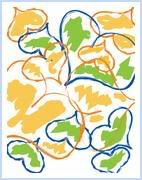
City Delights, or "Delightful City"
In the current Print Module we've started Adobe Illustrator; providentially, I'd learned some of the program last summer and did a little more in late fall, so it's not totally obscure. For the first part of this small, 20-point project, we had to trace shapes with the [scary?!] pen tool; the second phase, the one we turned in for grades, was to use the shapes to create a picture of anything but a beach scene. The shapes – which we could break apart into their separate components – were umbrella, cloud, waves, sailboat, palm tree, seashell and delivery truck. After I finished tracing, I spent a ton of time working with fills, lines, gradients, transforms and stacking orders. Then, when time got short, I designed an energetic, optimistic, happy urban paradise. 

Wednesday, February 08, 2006
summer dreams
We did this project in ImageReady, PhotoShop's web formatting component; it's a quick comp of the splashpage of a website, something you'd prepare for a client – without spending unreal amounts of time doing something that might not fly – to give them an idea of what you had in mind. This image includes additions not required by the minimum assignment directions.

Friday, February 03, 2006
photo retouching and colorizing: Harwich House
Wednesday I turned in my second major project; these notes are from my Artist's Statement.
194 Church Street, Harwich, Massachusetts
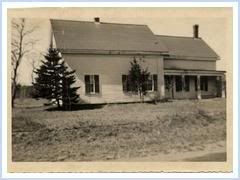
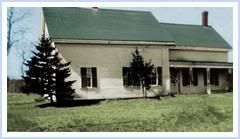
Image source: for this assignment I chose a black and white photograph of the house my grandparents first owned and later lived in at 194 Church Street in Harwich, on the vacation peninsula of Cape Cod, Massachusetts; they probably took this shot shortly after buying the property in the early 1950s. Clapboard siding and shake shingle roofs characterize most New England farm-style houses built on the Cape during the mid-to late 19th century.
Over the past few years I've scrapbooked many of the better snapshots of this house, but this one was in close to disreputable condition, making it a great candidate for repairing and colorizing!
Hoped-for outcome and rationale: because I have pictures taken after my grandparents made repairs, improvements and additions to both house and yard, I planned the colorizing to reveal what the house would have looked like when they first bought the property, before starting renovations and transformations.
Regarding the hues: always trying to avoid the temptation to imagine this project was supposed to look like a color photograph, I took some freedom with the color. I made the siding on the house creamy white, although an almost chalky white tends to be more typical of houses of that period in that geographical area. In addition, I aimed for pleasing (to me) interactivity among the roof, grass and sky colors. The original roof probably was green, but it might have been gray or brown.


194 Church Street, Harwich, Massachusetts
Image source: for this assignment I chose a black and white photograph of the house my grandparents first owned and later lived in at 194 Church Street in Harwich, on the vacation peninsula of Cape Cod, Massachusetts; they probably took this shot shortly after buying the property in the early 1950s. Clapboard siding and shake shingle roofs characterize most New England farm-style houses built on the Cape during the mid-to late 19th century.
Over the past few years I've scrapbooked many of the better snapshots of this house, but this one was in close to disreputable condition, making it a great candidate for repairing and colorizing!
Hoped-for outcome and rationale: because I have pictures taken after my grandparents made repairs, improvements and additions to both house and yard, I planned the colorizing to reveal what the house would have looked like when they first bought the property, before starting renovations and transformations.
Regarding the hues: always trying to avoid the temptation to imagine this project was supposed to look like a color photograph, I took some freedom with the color. I made the siding on the house creamy white, although an almost chalky white tends to be more typical of houses of that period in that geographical area. In addition, I aimed for pleasing (to me) interactivity among the roof, grass and sky colors. The original roof probably was green, but it might have been gray or brown.
Friday, January 27, 2006
images from my first print media project
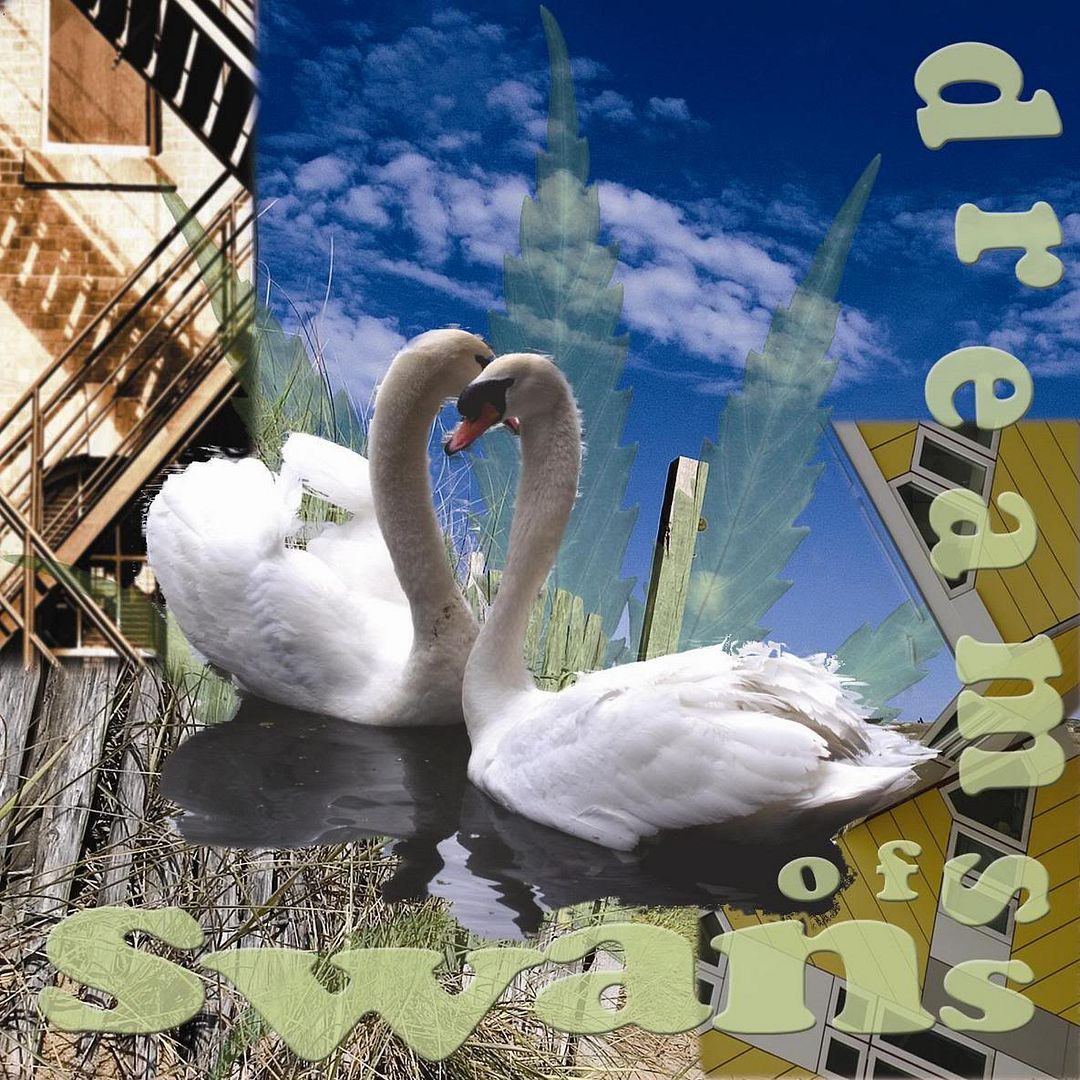
Tuesday was the date to turn in our first real project in the Interactive Media Certificate Program / IMCP Print Media module! We each got to pick a sometimes cryptic phrase...from a hat? I don't know, I left class a little early for Faith, Order, Witness, so Carolyn O'Barr, our Tuesday through Friday instructor, gave me Dreams of Swans, the only one left. We could choose to design a CD, DVD or book cover; I decided on a CD. Here's the front and the back! For the CD itself, I omitted the harder-edged urban fire escape on the upper left and Rotterdam roofs lower right, faded the cannabis leaf a little more and also made the swans less opaque. In addition, I rasterized the playlist and credits so I could move them away from the CD's center hole.


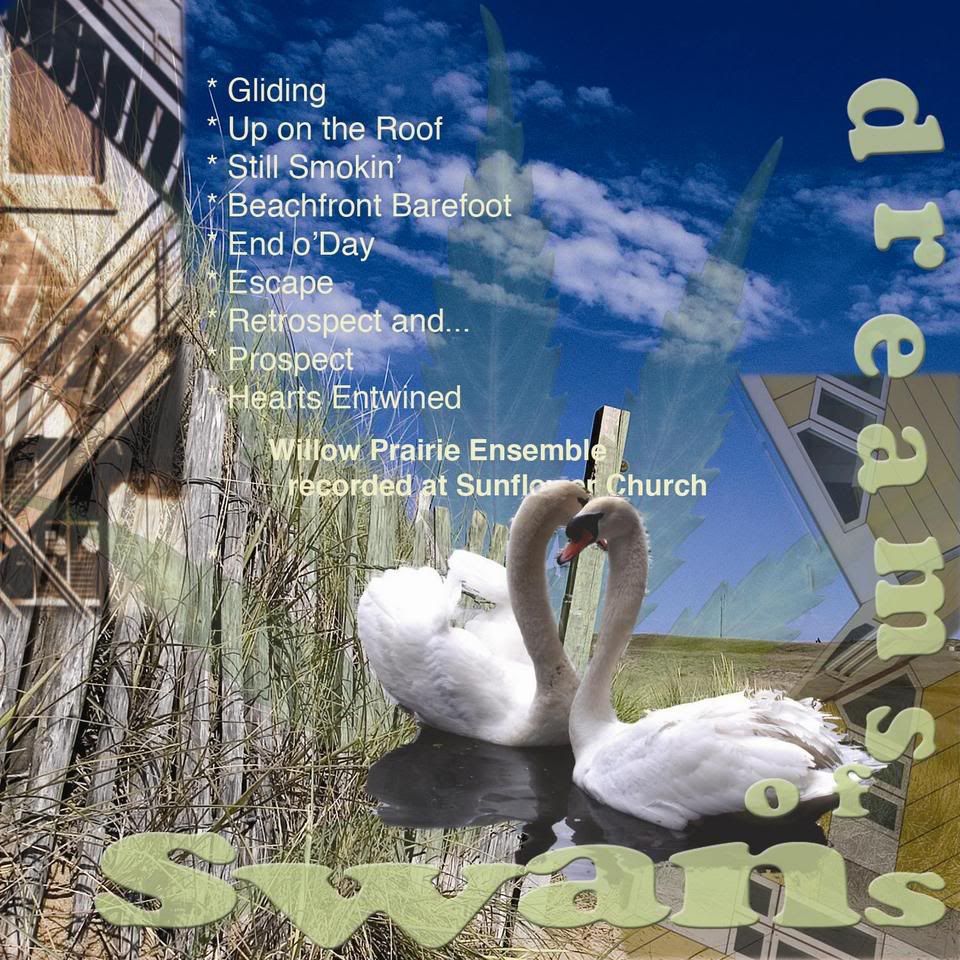
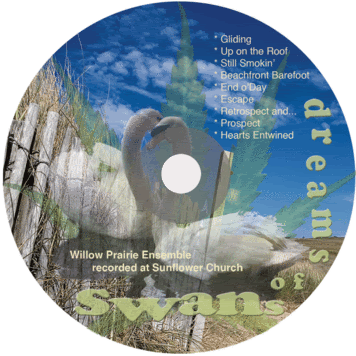
from my Artists Statement:
Creative Concept
- Swans
- Images of swan pairs posed so a heart forms between their heads are common, but I chose a swan couple forming almost a heart, illustrating the often tenuous, frequently fragile, inevitably changing bonds love and relationship form.
- Dune Grass
- From summers on Cape Cod – as well as time I've spent on the Eastern Shore of Maryland and Virginia – dune grass has become one of my favorite seashore symbols. The photography I chose particularly reminds me of Nauset and Chincoteague.
- Urban Fire Escape
- The subject is dreams, and where do multitudes of dreams emerge more insistently than in the residential and commercial structures of any inner city? Escape suggests going elsewhere than the daily mundane, and I love the dual imagery of "fire" both as a danger to be quenched and a crucial aspect of creativity.
- Rotterdam Rooftops
- For me, this image is polyvalent! Rotterdam is one of my favorite cities in what's probably my favorite country. In one of my former lives, the roof of the apartment building where I lived at 39 Clark Street in Boston's North End (a block away from Old North Church, "Christ Church in the City of Boston" of Paul Revere fame) was a great place to go to dream, do homework, sunbathe, visit with friends and just plain chill. Reinforced by the song "Up on the Roof" (I consider James Taylor's the real version), rooftops evoke a cascade of nostalgic memories and the slick, contemporary ones in this photograph cleanly dovetail with my current life and style.
- Cannabis Sativa Leaf
- Pipe dreams! Not exactly renowned as a hallucinogen, nevertheless marijuana tends to induce an altered, not-quite-real state of mind and being, so I chose this image to suggest a possible new reality superimposed upon rationalized 21st-century life.
Friday, January 06, 2006
New Books, Early January 2006, and some updated personal info
Here's the list of my new books; for details, you can click on the Amazon link. Over the next couple of months I'm planning to do more reading than recently I've been doing! In addition, this coming Monday I'll begin the 12-week long (plus spring break) Print Module in the Interactive Media Certificate Program—IMCP at the San Diego Community College District's North City Campus, which is a member of the international New Media Consortium. By the way, although I tried linking to the program's course listings the link wasn't specific enough, but according to the site listing this module will include: Mac Basics, Digital Graphics, Vector Graphics, Desktop Publishing, and Portable Document Forms. According to the material we received at orientation and registration, that'll be Photoshop, Illustrator, InDesign, Acrobat Pro and Portfolio development--the main reason this program interests me so. Since I'll be concentrating heavily on design, with 25 class hours per week, for the next near future I may try to make most of my blogs reflections on my current reading rather than my own theologizing.
Brueggemann, Walter. Texts That Linger, Words That Explode: Listening to Prophetic Voices
Walter Brueggemann, Awed to Heaven, Rooted in Earth: Prayers of Walter Brueggemann
Walter Brueggemann, Deep Memory, Exuberant Hope: Contested Truth in a Post-Christian World
Walter Brueggemann, Finally Comes the Poet: Daring Speech for Proclamation
Robert L. Millet, Kent P. Jackson, et al. Studies In Scripture, Vol. 4: 1 Kings to Malachi
Robert L. Millet et al. Studies in Scripture, Vol. 6: Acts to Revelation
Brueggemann, Walter. Texts That Linger, Words That Explode: Listening to Prophetic Voices
Walter Brueggemann, Awed to Heaven, Rooted in Earth: Prayers of Walter Brueggemann
Walter Brueggemann, Deep Memory, Exuberant Hope: Contested Truth in a Post-Christian World
Walter Brueggemann, Finally Comes the Poet: Daring Speech for Proclamation
Robert L. Millet, Kent P. Jackson, et al. Studies In Scripture, Vol. 4: 1 Kings to Malachi
Robert L. Millet et al. Studies in Scripture, Vol. 6: Acts to Revelation
Sunday, December 25, 2005
Christmas 2005, Tucson AZ
Sunday, December 25, 2005--I'm posting this predated, though right now it's actually the afternoon of December 31, a.k.a. New Year's Eve, and I'm back in San Diego.Another Christmas in the Sonoran desert, another remembering the old plus more new occasions of God's paradoxical Self-revelation, hidden yet now and again surprisingly discovered in, with and under the most mundane, the most common stuff of creation! Martin Luther, theologian of grace - and of the cross - so loved Christmas: he insisted that to see the fullness of God's Self-revelation we need to look to the Bethlehem manger and to the cross of Calvary. According to Luther, the humanly always-popular theology of glory amounts to lies and untruth, while theology of the cross is about the cutting-edge of Divine grace, mercy and truth. Uncovering the Divine in the desert's crazily beautiful bleakness is akin to finding the depth of God's sovereignty in subtleties rather than in sensations.
With at least a moderate flight of ideas, this is becoming as close to pure blog as I ever get, so I'll tell my readers my Advent email signature includes the second stanza of Philipp Nicolai's, "Wachet auf, ruft uns die Stimme"; since it first published in a 1599 collection, it's later than Luther, but how he would love "the strong in grace, in truth victorious!"
Zion hears the watchmen singing,It seems as if I've spent too much of the past baker's dozen years (yes, it has been that long) attempting to rebuild some kind of life. But for the past few days I've been contemplating and working on my sermon for New Year's day, 2006, and as usual, I'm mainly preaching about realities I need to hear! The RCL-designated pericope from Revelation 21:1-6 includes the spectacular vision of a new heaven and a new earth--a New Creation--the New Jerusalem, the new City of God:
And all her heart with joy is springing;
She wakes, she rises from her gloom;
For her Lord comes down all glorious,
The strong in grace, in truth victorious.
Her Star is risen, her Light is come.
Ah come, Thou blessed One, God’s own beloved Son:
Alleluia! We follow till the halls we see
Where Thou hast bid us sup with Thee.
Now I saw a new heaven and a new earth, for the first heaven and the first earth had passed away. ...Then I saw the holy city, New Jerusalem...The text includes the extravagant promise only God can ratify,
Then He who sat on the throne said, "Behold, I make all things new."I started this blog by including what continues as disappointing news to me (actually more like olds than news), that still my life has not rebuilt and renewed in even the remotest sense of again being full of the meaningful service for which I prepared and schooled. Seriously (am I ever much other than serious? Well, yes, often I'm casual or informal and almost never stand on ceremony), but I feel I've been existing on the boundaries of reality rather than living in the center! A while ago I took part in more than one discussion about center, heart, and periphery. The poet, prophet and theologian speak most authentically from the margins--have I not mentioned that almost too often lately? Sometimes I come close to angry at God for knowing I always think theologically and for giving me so many opportunities to be the theologian I hadn't seriously intended to become, but when life happened to me a little more intensely than I'd anticipated, I gave in and started doing lots more formal theology than planned (planned by me, that is). But I am incredibly looking forward to preaching death and resurrection on New Year's day, 2006, even though liturgically it's not Easter Sunday!
Continuing the Nativity facet of this article: Friday evening, December 23, I came into Tucson a few hours later than my usual flight into the southwestern sunset; night had descended, and despite Tucson's dark sky agreement, city lights shone and stars radiated clear in the cloudless desert cold. The following day, on Christmas Eve, at the start of 11 pm worship at St. Francis in the Foothills UMC, the pastor announced a theologian from HDS was visiting (that was me, believe it or not!). But back to the New Year's Day text from Revelation: And I heard a loud voice from heaven saying, "Behold, the dwelling-place of God is with humanity, and He will dwell with them, and they shall be His people." Next Sunday I'll be preaching death and resurrection; on a closely related note, I'm also planning to quote from this song written by Buddy Greene and Mark Lowry, which, by the way, was one of the many wonderful musical offerings on Christmas Eve:
Mary, Did You Know?
Mary, did you know that your baby boy will one day walk on water?
Did you know that your baby boy will save our sons and daughters?
Did you know that your baby boy has come to make you new?
This child that you've delivered will soon deliver you?
Mary, did you know that your baby boy will give sight to a blind man?
Did you know that your baby boy will calm a storm with his hand?
Did you know that your baby boy has walked where angels trod?
And when you kiss your little boy you've kissed the face of God?
Mary, did you know?
The blind will see, the deaf will hear, and the dead will live again
The lame will leap, the dumb will speak the praises of the Lamb?
Mary, did you know that your baby boy is Lord of all creation?
Did you know that your baby boy will one day rule the nations?
Did you know that your baby boy is heaven's perfect Lamb?
This sleeping child you're holding is the great I AM?
...the dead will live again, because this baby boy is the great I AM, the Word of Life that created us, redeems us, and continues sanctifying us, making us holy to stand before the Throne of Grace! Amen!
Monday, December 05, 2005
weeds and other ideas
~~from a Peanuts strip, date unknown, but it was a long time ago.~~
A couple of other favorites—a funky sometime-1970's era mag ad plus a Dutch return to reality:
Readers of this blog likely have figured out I've been trying to work through some life stuff theologically (the only way I know how!); at times I can be extremely codependent to the point of near self-negation—in the past my (sometimes) over-concern for others coupled with (sometimes) disregard for my own needs has gotten me a lot of compliments from people who perceive me as relatively selfless, but ultimately it has cost me. Ages ago someone said of me, "overdeveloped skills in reconciliation, accommodation and peacemaking!" I'm reading God's Politics by Jim Wallis (here's my blog about it,) and Wallis reminds us Jesus calls us not simply to love peace but to make peace. Only Jesus of Nazareth did absolutely everything right all of the time, but it is one thing to determine other people's words and actions aren't going to wag you, and it's something else altogether to persist in remaining in settings that have no benefit whatsoever for you (for me, that is) because you don't want to give people power over your life! And, of course, by doing that, a person does give others power...you know!
"You can roll with the punches!" Indeed I can, probably too easily compared to many people, meaning I can survive in situations that might flatten the average, more-coddled person. But ability to keep on keeping on in some sense does not quite equate with thriving, does it?
Peacemaking, making shalom
Biblical shalom means not a passive absence of conflict, not a feel-good surge of endorphins or serotonin, but fullness of life for everyone because of each person and every community having enough, possessing sufficient for their needs but not excess of anything. Those needs would include food, water, shelter, meaningful work, friends, community, recreation, ethical government and worship; it would include someplace (at least one place) they could be truly at home, as well as absence of armed conflict. Looks as if I'm remembering my Thanksgiving Eve blog and the Daily Bread taxonomy from Luther's Small Catechism, where Luther tells us Daily Bread includes Peace. To wish someone shalom - as a person-to-person greeting or in a more formal liturgical setting - means to desire they live in the fullness of life that bestows "enough" on everyone.
Weeds have a wide tolerance for environmental conditions and the rare ability to exploit recently disturbed territory.I don't recall the characters involved, but one asked the other, "What does that mean?" The reply: "You can roll with the punches!"
A couple of other favorites—a funky sometime-1970's era mag ad plus a Dutch return to reality:
Have you ever had a BAD time in Levi's®? (Remember the once-Ebonics idiomatic BAD that went mainstream?)Weeds, Peacemaking...
Geen vogel vliegt weer hoog of hij moet zijn kost op de aarde zoeken! Werkelijk!!!
Bible verse of the Day from Augsburg Fortress for Friday, November 11, 2005: Matthew 5:9:I am not sure how adequate this link is, but when I lived in Salt Lake City I served on the board and (needless to say?) did some writing for Interfaith Peacemaking/IPRCU. IPRCU wasn't very interfaith at all: a bunch of protestants and a unique New Ager whose biz card read, "Palmistry and Hypnotherapy"!
Blessed are the peacemakers, for they will be called children of God.
Readers of this blog likely have figured out I've been trying to work through some life stuff theologically (the only way I know how!); at times I can be extremely codependent to the point of near self-negation—in the past my (sometimes) over-concern for others coupled with (sometimes) disregard for my own needs has gotten me a lot of compliments from people who perceive me as relatively selfless, but ultimately it has cost me. Ages ago someone said of me, "overdeveloped skills in reconciliation, accommodation and peacemaking!" I'm reading God's Politics by Jim Wallis (here's my blog about it,) and Wallis reminds us Jesus calls us not simply to love peace but to make peace. Only Jesus of Nazareth did absolutely everything right all of the time, but it is one thing to determine other people's words and actions aren't going to wag you, and it's something else altogether to persist in remaining in settings that have no benefit whatsoever for you (for me, that is) because you don't want to give people power over your life! And, of course, by doing that, a person does give others power...you know!
"You can roll with the punches!" Indeed I can, probably too easily compared to many people, meaning I can survive in situations that might flatten the average, more-coddled person. But ability to keep on keeping on in some sense does not quite equate with thriving, does it?
Peacemaking, making shalom
Biblical shalom means not a passive absence of conflict, not a feel-good surge of endorphins or serotonin, but fullness of life for everyone because of each person and every community having enough, possessing sufficient for their needs but not excess of anything. Those needs would include food, water, shelter, meaningful work, friends, community, recreation, ethical government and worship; it would include someplace (at least one place) they could be truly at home, as well as absence of armed conflict. Looks as if I'm remembering my Thanksgiving Eve blog and the Daily Bread taxonomy from Luther's Small Catechism, where Luther tells us Daily Bread includes Peace. To wish someone shalom - as a person-to-person greeting or in a more formal liturgical setting - means to desire they live in the fullness of life that bestows "enough" on everyone.
Sunday, December 04, 2005
vintage
In my Adobe Illustrator class, we got to discussing the recent upsurge of vintage clothing (and vintage furniture, linens, tableware, ephemera, signage, whatever...) and their invariable, sometimes carefully computer-generated(!) imperfections amidst the formerly ubiquitous computer-produced graphic and photographic design with its exceptional preciseness. Increasingly I like wearing softer, more natural colors and textures, though I still enjoy America Classic denim jeans, shorts, skirts and shirts; unless they're brand new, denims are relatively soft and imperfect, too. At first it surprised me--now I expect it: over just the past couple of years (something about increasing chronology, too?) I keep finding myself hankering after softer, less defined colors, designs and styles in almost everything. "Almost everything" includes clothes, household textiles, furnishings and gear of all kinds (hmmm, except definitely not food and cuisine)--a sea change from those years of clean, crisp, angular Scandinavian and German design. However, my current habitat does not lack brightness and intensity, it likely never will, and I cannot envision living anywhere that would!
Regarding Denim, in times past, if you were wearing jeans or other denim to a high-end event, it always would be bright blue and new; these days it's rare to see denim matching that description much of anywhere, and when anyone dresses up in denim, to be remotely correct it absolutely always must be a vintage wash, with a vintage-variety shirt or blouse or jacket or vest or maybe more than one of those arranged in layers.
A few interesting notes I'd saved in one of my Commonplace Books:
retro nostalgia.
I so love true vintage (hey, close to antique) Jessica's Gunnies's Gunnesax; for contemporary, 21st century vintage styling that's far away from the modest prices of the originals, check out free people. Of course I keep on grooving to polo shirts, these days usually considered emo...there's a very comfort in dressing like times past, whether semi-hippie or hippy or emo or modified preppy--no tartans, please. This paragraph heading reads retro nostalgia, and as these days I'm feeling ultra-stressed, I'm finding it fun to look through old ads, magazine clippings, postcards (didn't I already mention ephemera?) and revisiting aspects of the (Egypts, maybe) past. Tired of this blog, too--time to do some more formal theology!
Regarding Denim, in times past, if you were wearing jeans or other denim to a high-end event, it always would be bright blue and new; these days it's rare to see denim matching that description much of anywhere, and when anyone dresses up in denim, to be remotely correct it absolutely always must be a vintage wash, with a vintage-variety shirt or blouse or jacket or vest or maybe more than one of those arranged in layers.
A few interesting notes I'd saved in one of my Commonplace Books:
- the word denim came from serge de Nimes, from the textile center of Nimes, France;
- dungaree after the east Indian city of Dhunga;
- jeans from working-class wear in Genoa, Italy.
- Levi's® evolved into a generic term from unsuccessful California gold-rusher Bavarian Levi Strauss' more-than-simply-successful denim pants endeavor.
- Here's an excellent brief history of denim and indigo.
retro nostalgia.
I so love true vintage (hey, close to antique) Jessica's Gunnies's Gunnesax; for contemporary, 21st century vintage styling that's far away from the modest prices of the originals, check out free people. Of course I keep on grooving to polo shirts, these days usually considered emo...there's a very comfort in dressing like times past, whether semi-hippie or hippy or emo or modified preppy--no tartans, please. This paragraph heading reads retro nostalgia, and as these days I'm feeling ultra-stressed, I'm finding it fun to look through old ads, magazine clippings, postcards (didn't I already mention ephemera?) and revisiting aspects of the (Egypts, maybe) past. Tired of this blog, too--time to do some more formal theology!
Thursday, December 01, 2005
Resurrection
God, you know how it goes
You've promised it; we've seen it
We believe it!
"Lord, I believe, help my unbelief!"
sleeping desert.
3 days and 3 nights
in the heart of the earth!
sounding over again I cannot stop hearing,
"In Jesus Christ's death and resurrection you can bury your need
to prove yourself."
dead and buried:
then, 3 days and 3 nights in the heart of the earth.
awaiting new birth?
Buried into darkness
Waiting for dawn
Dead and Buried
then dawnwalking!
My need to prove myself?
Lord, send a Fish and a resurrection:
You've promised it; we've seen it
We believe it!
"Lord, I believe, help my unbelief!"
sleeping desert.
3 days and 3 nights
in the heart of the earth!
sounding over again I cannot stop hearing,
"In Jesus Christ's death and resurrection you can bury your need
to prove yourself."
dead and buried:
then, 3 days and 3 nights in the heart of the earth.
awaiting new birth?
Buried into darkness
Waiting for dawn
Dead and Buried
then dawnwalking!
My need to prove myself?
Lord, send a Fish and a resurrection:
1. We sail a ship with a man named Jonah...
early in the morning.
2. Fall on your knees, for the sea is raging
3. Who is the guilty one among us?
4. Cast the lot, and the number's Jonah
5. Row, men, row to save this Jonah!
6. O Lord God, we've got to drown him.
7. Done, and the sea has ceased its raging.
8. Lord, send a fish and a resurrection.
9. What shall we do when the world is drowning?
10. Lord, send a fish and a resurrection...
Chorus:
Lord, our God, have mercy on us
early in the morning
Saturday, November 26, 2005
California: Anomie, Anchors and Attachments
Saturday, November 26, 2005
On Saturday, October 9, 2004, I posted this observation from the late theologian Henri Nouwen (1932-1996) on one of my currently inactive (inert?) blogs, sun country living:
California!!!!!
This is from The Road to Daybreak by Henri J. M. Nouwen:
I've said just a tad about California, Land o'Gold, so on to anomie. You probably remember studying Sociology with its trilogy of morose-looking practitioners: Émile Durkheim; Max Weber, and Karl Marx? Besides what I learned about him in sociology, not surprisingly my economics curriculum included a semester-long course on Marx! But regarding anomie and anomic, currently I'm living Clairemont, the section of San Diego that at one time (maybe through the 1950's? Not really quite sure on that one) was a leading New Town, and the near-anonymity this part of the city bestows on its residents is one of Clairemont's interesting aspects. As an example, some of the 9/11 terrorists lived in an apartment building not far from here and carried on their planning under their immediate neighbors' non-watchful eyes—now that's very "Clairemont." When I lived and served in Dorchester, Massachusetts, I was riding the subway from downtown after a layout and paste-up session for the local radical rag, when a stranger looked intently at me and commented on the Dorchester 3-decker houses t-shirt I was wearing: "I wouldn't advertise it!" Just maybe Living in Clairemont isn't much more something to broadcast than Living in Dorchester was!
Too often I think of but rarely speak about my sense of desolation in unaccountably losing the work and the relationships that literally defined me and absolutely helped anchor my life. The usual theological jargon insists Jesus Christ, our solid rock that never sinks, anchors us, whatever the storm. But better theology – particularly New Testament theology – insists the Church is the body of the Risen Christ and the local assembly of saints is a huge part of the evidence Jesus lives! My way-too-infrequent experiences of belonging have been too fragile and far too fleeting for comfort. Okay, so it's not about comfort, but how can a person function at all without a minimal level of being comfortably at home? In other words, no longer lost!
The God of Christianity—God of Abraham, Isaac and Jacob, God of the Hebrew prophets, God and Father of Jesus Christ, reveals Himself as a God of passionate attachments—to creation, and particularly to the people of His creation. God creates us in the Image of the Divine, and calls us to live up to that amazing image, living as people who jump into life with all four feet!
That's this evening's blog: A Most Blessed Advent to Everyone!
On Saturday, October 9, 2004, I posted this observation from the late theologian Henri Nouwen (1932-1996) on one of my currently inactive (inert?) blogs, sun country living:
California!!!!!
This is from The Road to Daybreak by Henri J. M. Nouwen:
[California] is a land to which people go to be free from tradition, constraints, and an oppressive history. But the price for this freedom is high: individualism, competition, rootlessness, and frequently loneliness and a sense of being lost. -page 198Freedom from tradition and constraints, but at a price... rootlessness:again I'll cite myself—I've posted this or something comparable several places, so I won't link to it:
Feeling rootless is part of the nature and reality of living the gospel; exactly like the Israelites of the Exodus, in Jesus Christ we live in the precariousness of nomadic, unsettled existence, daily undergoing baptism's departure from that old life and entrance into the new, each day recalling and reliving the perilous and risk-filled underwater moment in that watery font of death that at the same time is sustaining womb of new life, the fragile instant in which we need totally to trust the baptizer, who represents God, the One Who really baptizes.As I assess my history once more, I realize what little support it takes for me to feel alive again; I spent Thanksgiving afternoon and dinner with friends and felt whole while I was there at their house and I still felt very whole and very healed afterwards! However, by Friday, the day after, the doubts, lonesomeness and devastation were back ultra-big-time. Nouwen mentions loneliness and lostness, which still is exactly where I remain. My desire to find something, anything, to wipe out most of the memories is back, too. But now returning to this blog's title: California: Anomie, Anchors and Attachments.
The early church baptized in the flowing water of a river: just as every life moment is different, you can't step into the same river more than once! Living baptized means balanced on the threshold between our old lives of slavery to sin and self and our new lives of Eastered freedom for others, and living baptized means some times we also fleetingly experience the fullness of gospeled community. Many times I've pointed out for Israel the River Jordan had been the barrier separating them from the Promised Land and then became the boundary and border of their Promise Landed lives. Likewise, for us, baptism keeps defining us as different from those outside the community of the church at the same time baptism is an event that counts us into the covenanted people of God of all generations. Paul addresses his letter to the Corinthian Church "...together with all those who in every place call on the name of our Lord Jesus Christ, both their Lord and ours! Wherever we go we can find an assembly of Christians who call Jesus Lord, so we always can continue journeying together.
I've said just a tad about California, Land o'Gold, so on to anomie. You probably remember studying Sociology with its trilogy of morose-looking practitioners: Émile Durkheim; Max Weber, and Karl Marx? Besides what I learned about him in sociology, not surprisingly my economics curriculum included a semester-long course on Marx! But regarding anomie and anomic, currently I'm living Clairemont, the section of San Diego that at one time (maybe through the 1950's? Not really quite sure on that one) was a leading New Town, and the near-anonymity this part of the city bestows on its residents is one of Clairemont's interesting aspects. As an example, some of the 9/11 terrorists lived in an apartment building not far from here and carried on their planning under their immediate neighbors' non-watchful eyes—now that's very "Clairemont." When I lived and served in Dorchester, Massachusetts, I was riding the subway from downtown after a layout and paste-up session for the local radical rag, when a stranger looked intently at me and commented on the Dorchester 3-decker houses t-shirt I was wearing: "I wouldn't advertise it!" Just maybe Living in Clairemont isn't much more something to broadcast than Living in Dorchester was!
Too often I think of but rarely speak about my sense of desolation in unaccountably losing the work and the relationships that literally defined me and absolutely helped anchor my life. The usual theological jargon insists Jesus Christ, our solid rock that never sinks, anchors us, whatever the storm. But better theology – particularly New Testament theology – insists the Church is the body of the Risen Christ and the local assembly of saints is a huge part of the evidence Jesus lives! My way-too-infrequent experiences of belonging have been too fragile and far too fleeting for comfort. Okay, so it's not about comfort, but how can a person function at all without a minimal level of being comfortably at home? In other words, no longer lost!
The God of Christianity—God of Abraham, Isaac and Jacob, God of the Hebrew prophets, God and Father of Jesus Christ, reveals Himself as a God of passionate attachments—to creation, and particularly to the people of His creation. God creates us in the Image of the Divine, and calls us to live up to that amazing image, living as people who jump into life with all four feet!
That's this evening's blog: A Most Blessed Advent to Everyone!
Subscribe to:
Posts (Atom)